
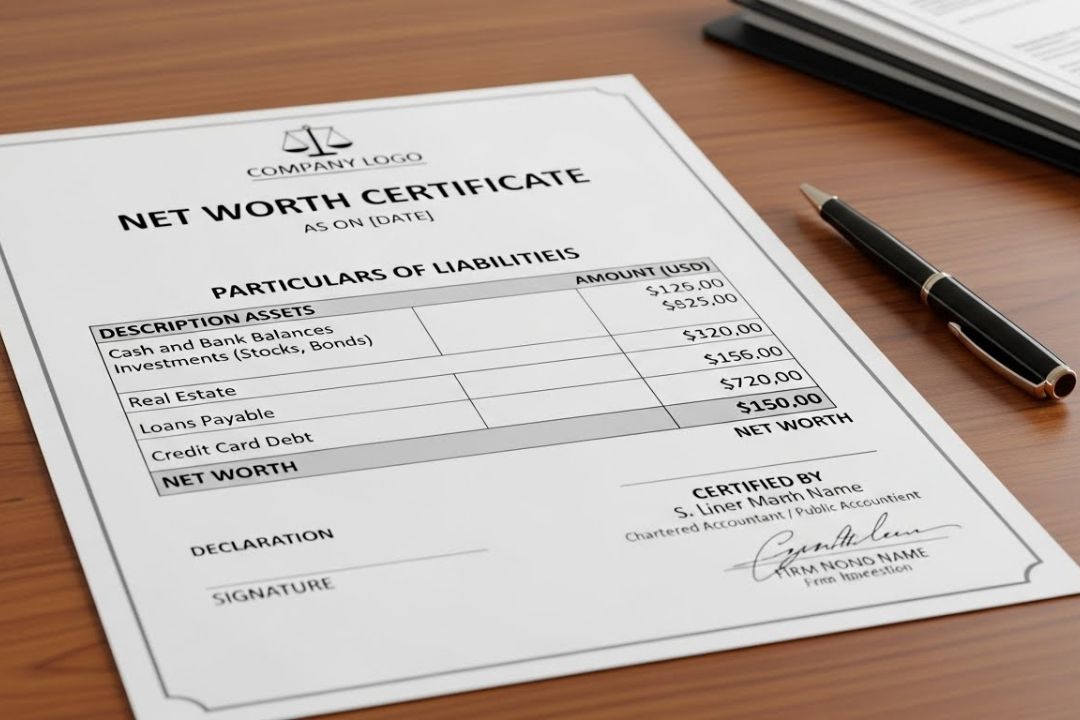
When you’re applying for a business loan, seeking a visa for international travel, or participating in a government tender, you’ll often encounter a crucial requirement: a net worth certificate. This financial document serves as proof of your economic standing and can make or break your application. Understanding the proper net worth certificate format is essential for anyone navigating these official processes. Whether you’re an entrepreneur, a professional planning to move abroad, or someone bidding on a contract, having accurate knowledge about this document can save you time, money, and potential rejections.
In this comprehensive guide, we’ll walk you through everything you need to know about net worth certificates, from their basic definition to the exact format required by different institutions. You’ll learn who can issue these certificates, what information they must contain, and how to avoid common mistakes that lead to application delays.
What Is a Net Worth Certificate?
A net worth certificate is an official financial document that provides a snapshot of an individual’s or company’s financial health at a specific point in time. Think of it as a financial report card that shows what you own minus what you owe.
This certificate calculates your total assets (properties, investments, cash, vehicles) and subtracts your total liabilities (loans, debts, obligations) to arrive at your net worth figure. Banks, immigration authorities, and government agencies rely on this document to assess whether you have sufficient financial backing for the purpose you’re stating.
For instance, if you’re applying for a business loan of five million rupees, the bank wants assurance that you have substantial assets backing your application. Similarly, visa officers for countries like the USA, Canada, or Australia want to ensure you can financially support yourself during your stay abroad.
Who Can Issue a Net Worth Certificate?
Not just anyone can prepare this important document. The net worth certificate format must be prepared and certified by specific authorized professionals to hold legal validity.
Authorized Professionals Include:
- Chartered Accountants (CAs) – Most commonly used for both individuals and businesses
- Cost Accountants – Primarily for corporate entities
- Company Secretaries – For company-related certifications
- Practicing Advocates – In certain legal contexts
Among these, Chartered Accountants are the most widely accepted professionals for issuing net worth certificates. They have the expertise to verify financial documents and are recognized by banks, embassies, and government departments across the country.
The CA will examine your financial statements, bank records, property documents, and other proof of assets before certifying your net worth. Their professional seal and signature give the document its legal standing.
Essential Components of Net Worth Certificate Format
When you receive a properly formatted net worth certificate, it should contain several mandatory elements. Missing any of these components could result in rejection of your application.
Header Information
The certificate begins with the CA’s letterhead, which includes their name, membership number, firm details, and contact information. This establishes authenticity right from the start.
Certificate Title and Reference Number
Every net worth certificate should have a clear title stating “Net Worth Certificate” and a unique reference number for tracking and verification purposes.
Recipient Details
The document must clearly identify who the certificate is being issued for, including full legal name, father’s name (if individual), address, and PAN number. For companies, the registered business name and incorporation details are required.
Purpose Statement
A clear statement explaining why the certificate is being issued (loan application, visa processing, tender participation) helps authorities understand the context.
Declaration of Net Worth
This is the heart of the document—a detailed breakdown showing:
- Total Assets: Including immovable property, investments, bank balances, vehicles, jewelry, and other valuables with their current market values
- Total Liabilities: All outstanding loans, credit card debts, mortgages, and financial obligations
- Net Worth Calculation: Assets minus liabilities equals net worth
Date of Assessment
The specific date on which the net worth is calculated must be clearly mentioned, as financial positions change over time.
CA’s Declaration and Signature
The certifying CA must include their declaration statement, along with their signature, seal, membership number, and date of certification.
Standard Net Worth Certificate Format for Bank Loans
When applying for bank loans, financial institutions have specific requirements for the net worth certificate format. Here’s what banks typically expect:
The certificate should begin with a formal address to the bank manager or loan officer. It must explicitly state that the certificate is being issued for loan application purposes.
Banks require a detailed asset breakdown categorized as:
Immovable Assets
- Residential properties with current market value
- Commercial properties
- Agricultural land
Movable Assets
- Bank deposits and savings
- Fixed deposits and recurring deposits
- Stocks, bonds, and mutual fund investments
- Vehicles (cars, two-wheelers)
- Gold, jewelry, and precious metals
Liabilities Section
- Existing home loans
- Personal loans
- Vehicle loans
- Credit card outstanding amounts
- Any business debts
Banks often reject certificates that show asset values without proper supporting documentation. Your CA should maintain copies of property valuation reports, bank statements, and investment proofs that were used to arrive at the certified figures.
Net Worth Certificate Format for Visa Applications
Immigration authorities have slightly different expectations when it comes to the net worth certificate format for visa purposes. Countries like Canada, Australia, the UK, and the USA scrutinize these documents carefully.
For visa applications, the certificate should emphasize liquid assets—money that can be readily accessed. While property and investments matter, embassy officials want to see sufficient cash reserves and easily convertible assets.
The format should include:
A statement certifying that the individual has a net worth of X amount as of a specific date. The document must mention that the person has adequate financial resources to support themselves during their stay abroad.
Many visa applications get rejected because the net worth certificate doesn’t align with other financial documents submitted. For example, if your certificate shows substantial savings but your bank statements reflect low balances, this inconsistency raises red flags.
Always ensure your visa-related net worth certificate includes amounts in both local currency and the destination country’s currency using current exchange rates.
Net Worth Certificate Format for Government Tenders
Participating in government tenders requires demonstrating financial capability, and the net worth certificate format for this purpose follows specific guidelines.
Government departments typically specify minimum net worth requirements in tender documents. Your certificate must clearly show that you meet or exceed these requirements.
The format should include:
- Company registration details and GST number
- Audited financial statements for the past three years
- Detailed asset and liability statement
- Confirmation that the company has a net worth of at least the specified amount
- CA’s attestation that the figures are based on audited accounts
For tender applications, authorities often cross-verify the information with your Income Tax Returns and audited balance sheets. Any discrepancies can lead to disqualification, even if you’re the lowest bidder.
Step-by-Step Process to Obtain a Net Worth Certificate
Getting your net worth certificate involves several steps, and understanding this process helps you prepare better.
Step 1: Gather Financial Documents
Collect all relevant documents including property papers, bank statements for the past six months, investment portfolios, vehicle registration certificates, loan statements, and credit card bills.
Step 2: Calculate Preliminary Net Worth
Before approaching a CA, do a rough calculation of your assets and liabilities. This gives you an idea of your standing and helps you determine if you meet the requirements for your purpose.
Step 3: Approach a Chartered Accountant
Choose a practicing CA with good credentials. Discuss your purpose clearly so they can prepare the certificate according to the specific format required.
Step 4: Document Verification
The CA will verify all your documents, may ask for additional proof, and might even conduct independent valuation for certain assets.
Step 5: Certificate Preparation
Once satisfied with the verification, the CA prepares the certificate on their letterhead following the appropriate net worth certificate format.
Step 6: Attestation and Sealing
The final step involves the CA signing, sealing, and dating the certificate, making it legally valid.
The entire process typically takes 3-7 working days, depending on the complexity of your financial situation and the CA’s workload.
Common Mistakes to Avoid
Many applications get delayed or rejected due to errors in the net worth certificate format. Here are mistakes you should avoid:
Inflating Asset Values: Showing property or investments at values higher than market rates can backfire when authorities conduct verification. Always use realistic, current market values.
Hiding Liabilities: Omitting loans or debts might seem advantageous, but it constitutes fraud. Tax records and credit bureau reports will reveal these liabilities anyway.
Using Outdated Certificates: A net worth certificate older than six months is generally not accepted. Always get a fresh certificate for each application.
Incorrect CA Details: Ensure your CA’s membership number, registration details, and contact information are accurate. Authorities often verify these details directly with the Institute of Chartered Accountants.
Vague Asset Descriptions: Instead of writing “property value: 50 lakhs,” specify the address, type, size, and current market value based on recent transactions in the area.
Missing Supporting Documents: Always attach copies of supporting documents with your certificate. This includes property valuation reports, bank statements, and investment proofs.
Cost of Obtaining a Net Worth Certificate
The professional fees for getting a net worth certificate vary based on several factors. Understanding these costs helps you budget appropriately.
For individuals with straightforward finances (salaried professionals with one property and standard investments), CA fees typically range from 2,000 to 5,000 rupees.
Business owners or individuals with complex financial portfolios involving multiple properties, diverse investments, and international assets may pay between 5,000 and 15,000 rupees.
Corporate net worth certificates for tender applications or significant loan amounts can cost anywhere from 10,000 to 50,000 rupees, depending on company size and complexity.
Additional costs may include property valuation fees if you need professional assessment of real estate assets, which can range from 3,000 to 10,000 rupees per property.
Remember that choosing the cheapest CA isn’t always wise. A properly prepared certificate following the correct net worth certificate format is worth the investment, as errors can cost you much more in terms of rejected applications and lost opportunities.
Validity Period of Net Worth Certificate
Unlike some documents that remain valid for years, net worth certificates have a relatively short validity period because financial situations change rapidly.
Most banks accept certificates issued within the past three to six months. For loan applications, anything older is generally rejected because banks need current financial information to assess risk.
Visa applications typically require certificates dated within three months of application. Immigration authorities want assurance of your current financial status, not what it was a year ago.
Government tenders usually specify validity requirements in the tender document itself, often requiring certificates dated within six months before the tender submission date.
If your application process takes longer than expected and your certificate expires, you’ll need to obtain a fresh one. This is why it’s advisable to get your net worth certificate only after you’re ready to submit your complete application.
Difference Between Net Worth Certificate and Solvency Certificate
Many people confuse these two documents, but they serve different purposes and follow different formats.
A solvency certificate is a simpler document that merely confirms you’re financially solvent—meaning you can pay your debts. It doesn’t provide detailed asset and liability breakdowns.
In contrast, a net worth certificate provides comprehensive financial information with exact figures for all assets and liabilities. It’s more detailed and offers a complete picture of your financial standing.
Banks generally prefer net worth certificates for significant loan amounts because they provide better insight into your financial capacity. Solvency certificates might suffice for smaller loans or guarantor purposes.
For international visa applications and government tenders, only net worth certificates are accepted because authorities need detailed financial information.
Digital Verification and Authentication
With increasing digitization, the verification process for net worth certificates has evolved significantly.
Many banks and government departments now verify the CA’s credentials electronically through the ICAI (Institute of Chartered Accountants of India) database. They check the membership number and ensure the CA is in valid practice.
Some institutions use digital signature certificates (DSC) for authentication. CAs with DSC can issue digitally signed net worth certificates that contain encrypted authentication codes.
Embassy officials often contact the issuing CA directly via email or phone to verify certificates for visa applications. This is why providing accurate contact details of your CA is crucial.
Blockchain-based verification systems are emerging in some sectors, allowing instant authentication of financial documents without manual verification.
Recent Changes and Updates
Financial regulations and documentation requirements evolve constantly. Staying updated on the latest net worth certificate format requirements is important.
Following the implementation of GST, business net worth certificates must now include GST registration details where applicable. This helps authorities cross-verify business finances with GST returns.
Post-pandemic, many banks have started accepting digitally signed certificates via email, reducing the need for physical document submission. However, always confirm with your specific bank or institution.
New FEMA regulations have introduced additional disclosure requirements for individuals with foreign assets or international income sources. These must be reflected in your net worth certificate when applying for certain purposes.
The introduction of Aadhaar-based verification has made the authentication process faster. Many CAs now include Aadhaar numbers in certificates for quick verification.
Conclusion
Understanding the correct net worth certificate format is no longer optional—it’s essential for anyone dealing with banks, embassies, or government departments. This document serves as your financial identity proof, opening doors to loans, international travel, and business opportunities.
Getting it right the first time saves you from application rejections, delays, and financial losses. Always work with qualified Chartered Accountants who understand the specific requirements of your purpose. Ensure all information is accurate, current, and supported by proper documentation.
Whether you’re an entrepreneur seeking funding, a professional planning to migrate abroad, or a businessperson bidding on tenders, investing time and resources in obtaining a properly formatted net worth certificate is one of the smartest decisions you can make.
Don’t wait until the last minute—start gathering your financial documents today, consult with a qualified CA, and get your net worth certificate prepared well before you need it. Your future opportunities may depend on this single document.